
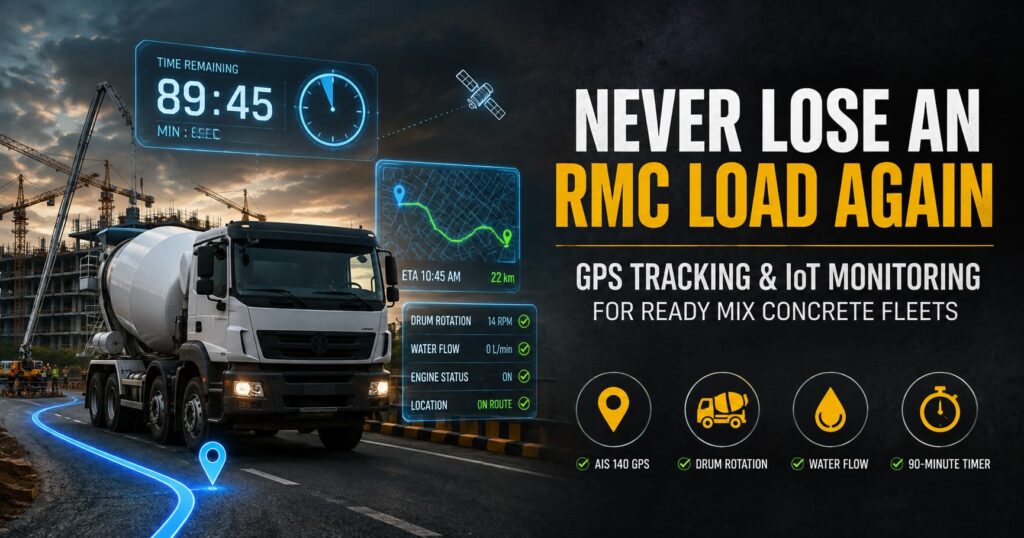
Your transit mixer left the plant at 9:15am with a full drum of M30 concrete.
The site is 22 kilometres away. Normal travel time: 35 minutes. The concrete has a maximum life of 90 minutes from the time water was added at the plant, as per IS 4926:2003. By your calculation, the truck should be back at the plant by 11:30am for the next load.
At 10:45am, the site engineer calls. The truck has not arrived.
You call the driver. No answer. You check your dispatch sheet. Nothing tells you where the truck is right now, whether the drum is still rotating, or whether the concrete is still usable.
At 11:10am, the truck arrives. The driver says he was stuck in traffic. The site engineer says the concrete looks dry. He adds water on-site to make it workable again.
You have just delivered compromised concrete to a structure. The mix design is wrong. The compressive strength will be lower than specified. And you have no data to prove it did or did not happen.
This scenario plays out at RMC plants across India every day. GPS and IoT tracking on transit mixers stops it completely.
The 90-Minute Problem That Defines RMC Operations
Ready-mix concrete is not like other cargo. You cannot stop, park, and wait. You cannot reroute to a closer delivery if the original site is unavailable. You cannot hold inventory.
IS 4926:2003, the Bureau of Indian Standards specification for ready-mixed concrete, is unambiguous: concrete must be discharged within 90 minutes of water being added to the mix, OR before the drum completes 300 revolutions — whichever comes first.
Beyond that window, the concrete’s workability drops, the hydration process advances beyond the point of recovery, and the resulting structure may not meet the design compressive strength. For an M30 grade specification, a contractor discovering understrength concrete in a completed pour faces a crisis — possible demolition, retesting, disputes, and liability.
This time pressure is why RMC operations cannot be managed with manual dispatch sheets and driver phone calls. Every minute of visibility lost between plant and site is a minute closer to a concrete rejection.
What Goes Wrong Without a Tracking and IoT System
1. Unauthorized stops and route deviations
Transit mixer drivers make unauthorized stops for multiple reasons — personal errands, waiting out traffic, side jobs, meeting contacts. Without GPS tracking, a plant manager has no way to know a truck stopped for 25 minutes at a dhaba on the way to site. Those 25 minutes come directly out of the 90-minute concrete window.
On a single truck making 5 trips per day, unauthorized stop time averaging 20 minutes per trip adds up to more than 1.5 hours of concrete shelf-life lost daily — on one truck alone.
2. Unauthorized water addition on-site
This is one of the most damaging and least visible problems in RMC operations. When concrete becomes stiff during transit due to delay or high temperatures, drivers and site workers add water directly to the drum to restore workability. Adding water increases the water-cement ratio and directly reduces compressive strength — sometimes by 20–30% for every additional 10 litres added.
Without a water flow sensor on the truck, there is no record of whether water was added, how much, and at what point in the journey. The site gets workable concrete. The structure gets weakened concrete. Nobody knows until a cube test fails 28 days later — or worse, the structure shows distress after years of service.
3. Drum rotation violations
The drum must rotate continuously throughout transit to keep the mix homogeneous. A drum that stops rotating allows the aggregate to settle, the cement to begin setting, and the mix to stratify — concrete that cannot be rescued by agitation alone once it has set at the bottom.
Without a drum rotation sensor, a plant has no way to know if the drum stopped rotating during a 45-minute journey. The driver delivers the concrete, it is poured, and the weakness is invisible until structural testing.
4. No proof of compliance
When a structural failure or quality dispute occurs, the RMC supplier is among the first parties investigated. Without a complete digital record — departure time from plant, route taken, drum rotation log, water addition log, arrival time at site, discharge duration — the RMC company has no data to defend itself.
Manual delivery challan books are not adequate defence in a technical or legal dispute. A time-stamped IoT data trail is.
5. Fuel waste and inefficient fleet utilisation
Without GPS visibility, dispatchers cannot see which truck is closest to the plant when a batch is ready, cannot verify actual trip times against expected times, and cannot identify trucks that are idle with the engine running between trips. On a fleet of 10 transit mixers, fuel waste from idle running and inefficient dispatch alone can exceed ₹50,000 per month.
How the Elogs RMC Vehicle Tracking and IoT Monitoring System Works
The Elogs system is purpose-built for ready-mix concrete operations. It is not a generic GPS tracker adapted for RMC — it integrates vehicle tracking with concrete-specific IoT sensors into a single dashboard designed around the 90-minute window.
AIS 140 Certified GPS Tracker
Every RMC transit mixer is a heavy commercial vehicle and requires an AIS 140 certified GPS tracking device under Indian regulations. The Elogs GPS tracker is ARAI-certified, AIS 140 compliant, and transmits location data every 30 seconds via 4G/LTE.
From the plant control room, the dispatcher sees every truck on a live map — current location, speed, direction, and estimated time to site. Route deviations trigger an automatic alert. Unauthorized stops beyond a defined duration (configurable — for example, more than 5 minutes in a non-approved location) send an SMS to the plant manager immediately.
Drum Rotation Sensor
This is the sensor that transforms a GPS tracker into a true RMC monitoring system.
A precision drum rotation sensor is fitted to the transit mixer’s drum drive mechanism. It monitors:
- Whether the drum is rotating or stopped
- Current rotation speed (RPM)
- Direction of rotation — mixing direction (charging/transit) versus reverse rotation (discharging)
- Cumulative revolution count since loading — tracked against the IS 4926 limit of 300 revolutions
The dashboard displays drum status in real time. If the drum stops rotating during transit, an alert fires immediately. The system also flags when the drum switches to discharge rotation before the truck has reached the designated delivery geofence — indicating the driver may be discharging at an unauthorised location.
The revolution count provides a digital record of IS 4926 compliance for every single load delivered.
Water Flow Sensor
A calibrated water flow sensor is fitted to the truck’s on-board water system. Every time water is added to the drum, the system records:
- Volume of water added (in litres)
- Time of addition
- Location at the time of addition (GPS-correlated)
- Whether addition was at the plant (legitimate — part of mix design) or in transit/on-site (unauthorised)
If water is added during transit or on-site beyond a permitted threshold, an alert goes to the plant quality manager immediately. The digital record creates an unambiguous audit trail — if a concrete sample fails a cube test, the water flow log shows exactly what happened and when.
Concrete Shelf Life Timer
The system starts a countdown timer from the moment the batch is loaded and the water-addition record is initiated at the plant. The timer runs on the dashboard for every active truck, showing:
- Time elapsed since loading
- Time remaining before the 90-minute IS 4926 limit
- Revolution count against the 300-revolution limit
Dispatchers can see at a glance which trucks are approaching their limit, and prioritise routing or alert site engineers to be ready for discharge.
Temperature Monitoring (Optional)
For operations in high-ambient-temperature conditions — common across India from March to June — a drum temperature sensor provides an additional safeguard. Concrete in a drum exposed to direct sun in 42-degree heat hydrates significantly faster than at 25 degrees. Temperature logging provides additional data for quality documentation and for adjusting batch water requirements.
Geofencing for Plant, Routes, and Sites
Geofences are configured for:
- The plant — truck entering and exiting the plant triggers automatic trip logging
- Approved routes — deviation from the approved route sends an alert
- Delivery sites — arrival at the delivery geofence starts the discharge monitoring clock and notifies the site engineer automatically
- Restricted zones — if a truck enters an area outside its permitted operational zone, the plant is alerted
Cloud Dashboard and Reports
All data — GPS track, drum rotation, water addition, shelf life timer, geofence events — appears in the Elogs cloud dashboard in real time. Plant managers, dispatch supervisors, and quality teams each have their own view.
Automated reports generated daily include:
- Trip-by-trip log: departure time, route, arrival time, drum rotation count, water added, discharge time
- Fleet utilisation: number of trips per truck, idle time, turnaround time
- Quality compliance summary: loads delivered within IS 4926 limits vs. total loads
- Fuel consumption report: litres consumed per trip and per truck
- Exception report: all alerts triggered — stops, deviations, drum halts, water additions
For RMC companies delivering to large infrastructure projects, government contracts, or real estate developers with quality audit requirements, these automated reports are the documentation standard their clients increasingly demand.
What Changes After Deploying the Elogs RMC Tracking System
Concrete rejection rates drop. Research on RMC fleet telematics deployments in India shows rejection rates falling by 10–15% after IoT monitoring implementation. With shelf-life visibility and drum rotation alerts, the root causes of rejection — delayed delivery, drum stops, improper water addition — are caught before they reach the pour.
Dispatchers stop guessing. Live truck positions replace phone calls to drivers. Dispatch decisions — which truck to send next, whether to hold a batch, whether to alert a site about a delay — are based on data, not estimates.
Unauthorised water addition becomes impossible to hide. When drivers know the water flow sensor records every addition, behaviour changes immediately. Cube test failure rates fall in direct proportion.
Turnaround time improves. GPS data reveals where time is actually lost in the trip cycle — at the plant gate, in transit, waiting at site for the crane or pump, during washing. Visible data creates the basis for operational improvement.
The fleet does more with fewer trucks. Better dispatch, fewer unauthorized stops, and faster turnaround mean each transit mixer completes more trips per day. For a 10-truck fleet, an improvement of even 0.5 trips per truck per day is 5 additional loads — significant revenue with no additional vehicle cost.
You have compliance documentation. Every load delivered has a complete IoT record — departure time, drum revolutions, water added, arrival time, discharge time. IS 4926 compliance is no longer a manual attestation on a delivery challan. It is a digital record in the cloud, exportable for any audit or dispute.
Who Benefits from the Elogs RMC Tracking System
RMC plant operators with fleets of 5 to 200+ transit mixers gain complete operational visibility, quality documentation, and the fleet utilisation data needed to grow efficiently.
Infrastructure contractors running captive RMC plants for highway, metro, or bridge projects need the IS 4926 compliance records and quality trail that their project quality plans mandate.
Real estate developers with dedicated RMC supply need concrete quality assurance that manual methods cannot provide — particularly for high-specification grades (M35 and above) used in structural members.
Concrete pump and transit mixer rental companies need GPS tracking for asset location and utilisation, and drum monitoring to verify that equipment is being used within operational parameters.
The Elogs Advantage for RMC Operations
Purpose-built for RMC, not adapted from generic fleet tracking. The drum rotation sensor, water flow sensor, and shelf-life timer are designed specifically for ready-mix concrete operations. Generic GPS trackers do not have these.
AIS 140 certified GPS hardware. Compliance with Indian regulatory requirements is built in — no separate device needed for RTO compliance.
Single dashboard for all sensors. GPS location, drum status, water addition, and shelf-life countdown are integrated into one screen. Dispatchers do not switch between systems.
Real-time alerts, not end-of-day reports. Alerts for drum stops, route deviations, unauthorised water addition, and shelf-life warnings go out the moment the event occurs — not in a morning summary when the concrete has already been poured.
Automated IS 4926 compliance documentation. Revolution counts, water addition logs, and time records are stored automatically and exportable on demand.
Pan-India installation and 24/7 support. Elogs has installation teams and technical support across India. For RMC companies operating across multiple cities or states, this matters — a sensor fault in Pune at 6am needs local support, not a ticket that gets resolved in 48 hours.
Scalable from 5 to 500 trucks. Whether you run a single-plant operation with 8 transit mixers or a multi-city RMC network, the Elogs platform scales without changes to the user experience.
Frequently Asked Questions
Is GPS tracking mandatory for RMC transit mixers in India? RMC transit mixers are heavy commercial vehicles and are subject to AIS 140 GPS tracking requirements for vehicles on permit. Compliance requirements vary by state, but the mandatory AIS 140 framework applies to commercial transport vehicles. Beyond regulatory compliance, most large infrastructure project specifications now require digital tracking records for RMC deliveries.
How is the drum rotation sensor installed on a transit mixer? The drum rotation sensor is fitted to the drum drive mechanism — either the drive shaft or the drum ring gear — by Elogs’ trained installation technicians. Installation is non-intrusive and does not require modification to the truck’s structural components. Installation per truck typically takes 3–4 hours.
Can the system detect if the driver adds water to the drum on-site? Yes. The water flow sensor records every activation of the truck’s on-board water system, with GPS-correlated location. Water additions during transit or on-site are flagged as exceptions and alert the quality manager immediately.
What happens if a truck goes into an area with no mobile network? The Elogs IoT gateway stores data locally when network connectivity is unavailable and transmits the full data log automatically when connectivity is restored. The system also uses dual-SIM connectivity with automatic failover to maximise uptime in areas with patchy coverage.
How does the shelf life timer work? The timer starts from the moment the batch is loaded and initiated at the plant. The countdown runs in real time on the dashboard and generates alerts at configurable intervals — for example, at 60 minutes elapsed and 75 minutes elapsed — giving dispatchers and site engineers warning before the 90-minute IS 4926 limit is reached.
Can the system generate IS 4926 compliance reports automatically? Yes. For each load, the system generates a digital record including departure time, drum revolution count, water additions (volume, time, location), arrival time, and discharge time. These records can be exported in standard formats for project QA documentation, client audits, or regulatory requirements.
What is the typical ROI for an RMC company deploying this system? ROI depends on fleet size and current operational losses. For most RMC operators, the primary savings come from reduced concrete rejection rates (10–15% reduction reported in industry deployments), elimination of unauthorised water addition, improved fleet utilisation (0.3–0.5 additional trips per truck per day), and fuel savings from idle reduction. Most operators with fleets of 10 or more trucks report full cost recovery within 3–6 months.
If your transit mixers are leaving the plant without a digital record of what happens between loading and discharge, you are accepting quality risk, operational waste, and compliance exposure as normal business costs.
They are not normal. They are fixable.
Talk to the Elogs team to see the RMC tracking and IoT monitoring system and get a quote for your fleet.
Elogs Technology provides GPS tracking and IoT monitoring solutions for RMC transit mixers, construction fleets, and industrial vehicles across India. Our RMC system integrates AIS 140 certified GPS, drum rotation sensors, water flow sensors, and shelf-life monitoring in a single cloud platform. Contact us to discuss your RMC operation.