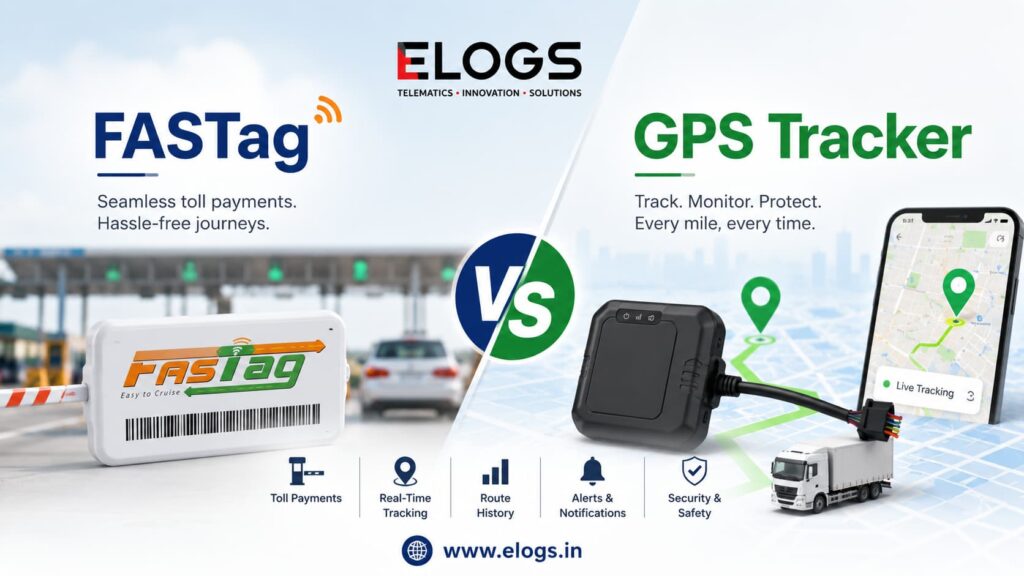
FASTag does track your vehicle, but not in the way most people expect.
Every time your vehicle passes a toll plaza, FASTag records the location, timestamp, direction of travel, and transaction amount. That data is stored by NHAI and your issuing bank. You can see a history of toll crossings in your FASTag app or bank statement.
What FASTag does not give you is real-time GPS location. No live map. No speed monitoring. No geofencing alerts. No dashboard showing where your vehicle is right now.
And since April 2026, FASTag 3.0 has changed part of this equation, but not in the way most fleet operators assume. More on that below.
Here is a question for every fleet owner in India.
Your truck left your depot at 6am. FASTag shows it crossed a toll plaza at 8am near Hosur. The next FASTag transaction is at 1pm near Krishnagiri, 90 kilometres away.
Five hours. 90 kilometres. What happened in between?
Did your driver take a two-hour break at a dhaba? Did he detour 30 kilometres off-route to run a personal errand? Did he drive at 100km/h through a school zone? Did he let someone else drive the vehicle for an hour?
FASTag has no idea. It only knows your truck passed two toll booths. Everything that happened between those two booths is invisible.
This is the gap that a GPS tracker fills. And understanding the difference between the two is one of the most important things a fleet owner in India can know.
Does FASTag Track Your Vehicle’s Location?
No. FASTag does not track your vehicle’s location.
FASTag is a toll payment system. It uses RFID (Radio Frequency Identification) technology to automatically deduct toll charges when a vehicle passes through a FASTag-enabled plaza, without the vehicle having to stop. That is its entire purpose.
FASTag records:
- That your vehicle passed a specific toll plaza
- The exact time of that toll crossing
- The toll amount deducted
- Your account balance after the deduction
FASTag does not record:
- Your vehicle’s location between toll plazas
- Your vehicle’s speed at any point
- The route your driver actually took
- How long your vehicle idled or stopped
- Anything that happens away from a toll booth
If your route has no toll plazas, FASTag gives you zero data about that journey.
What Does a GPS Tracker Tell You?
A GPS tracker gives you continuous, real-time visibility of your vehicle, whether it is on a toll road, a state highway, a village road, or parked in a compound.
A GPS tracker records:
- Real-time location updated every 30 seconds (or faster)
- Speed at every moment of the journey
- Route taken from origin to destination
- Every stop: where, when, and for how long
- Idle time: engine running but vehicle not moving
- Harsh braking, harsh acceleration, and overspeeding events
- Geofence alerts when the vehicle enters or exits a defined area
- Trip history going back weeks or months
- Engine on/off status
For a fleet of 10 trucks, this data tells you more in one day than FASTag tells you in a month.
FASTag vs GPS Tracker: Side-by-Side Comparison
| Feature | FASTag | GPS Tracker |
|---|---|---|
| Real-time location | No | Yes |
| Location between toll plazas | No | Yes |
| Speed monitoring | No | Yes |
| Route history | No | Yes |
| Idle time tracking | No | Yes |
| Driver behaviour | No | Yes |
| Geofencing and alerts | No | Yes |
| Works on non-toll roads | No | Yes |
| Panic button | No | Yes (AIS 140 devices) |
| Toll payment | Yes | No |
| AIS 140 compliance | No | Yes (certified devices) |
| Monthly data cost | Low | Moderate |
Is FASTag Enough for AIS 140 Compliance?
No. FASTag does not satisfy AIS 140 compliance requirements.
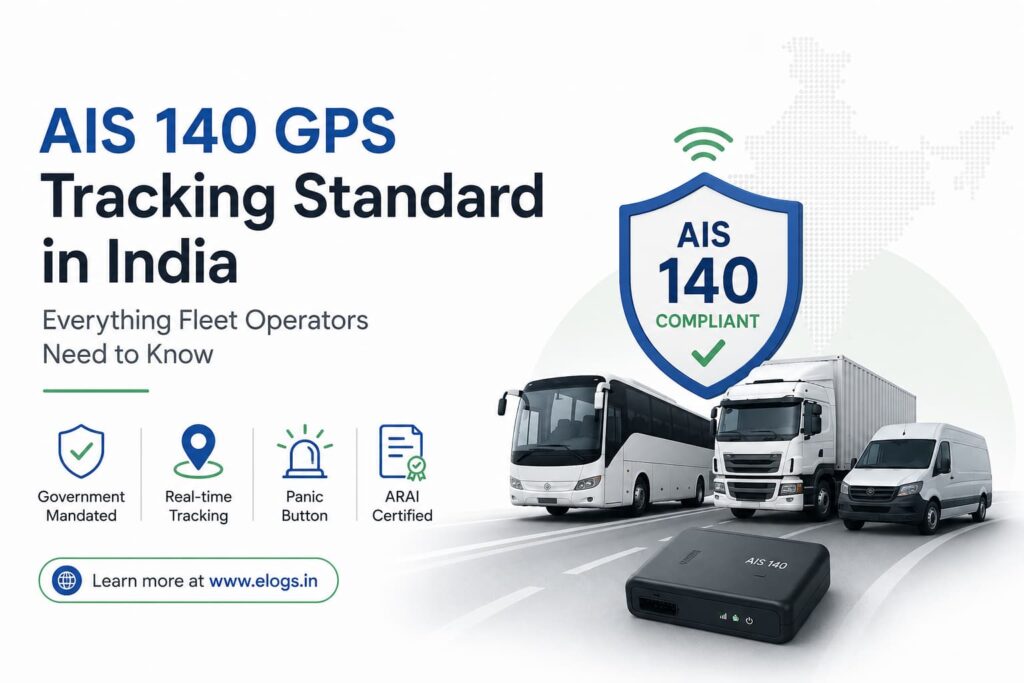
AIS 140 is the Government of India’s vehicle tracking standard, mandated by the Ministry of Road Transport and Highways (MoRTH). It applies to all public service vehicles, commercial vehicles on permit, and school buses.
AIS 140 requires:
- A certified GPS tracking device installed in the vehicle
- Real-time location transmission to government control centres
- NavIC satellite support (India’s own navigation system)
- A panic button for driver safety
- ARAI certification of the device
FASTag satisfies none of these requirements. FASTag is a NHAI (National Highways Authority of India) toll collection system and has nothing to do with MoRTH’s vehicle tracking mandate.
Many fleet operators make the mistake of assuming that because they have FASTag, they are compliant on vehicle tracking. They are not, and vehicles without AIS 140 certified devices risk permit cancellation and fines at checkpoints.
The Stolen Vehicle Test
Imagine your truck is stolen overnight.
With only FASTag, you know nothing until the thief drives through a toll plaza. If he avoids toll roads, you may never get a FASTag alert at all. If he does cross a toll, you know which plaza he passed, but not where he went after that.
With a GPS tracker, you can see exactly where your vehicle is right now. You can share a live location link with police. You can set up a geofence alert that triggers the moment the vehicle moves outside its authorised area, even at 3am. Many GPS systems allow remote immobilisation, cutting the engine once the vehicle is stationary.
FASTag is not a theft recovery tool. GPS is.
The Fuel Cost Test
Fuel is the single biggest expense for most fleets in India, typically 35 to 40 percent of total operating costs.
FASTag tells you nothing about fuel. It does not know how long your driver idled at a truck stop burning diesel while the engine ran. It does not know if your driver took a longer route that added 40 kilometres to the journey. It does not flag harsh acceleration events that increase fuel consumption by 15 to 20 percent.
GPS trackers give fleet managers the data to reduce idle time, enforce optimal routes, and coach drivers on fuel-efficient behaviour. Fleets that actively use GPS data for fuel management typically reduce fuel costs by 10 to 20 percent.
On a fleet of 10 trucks running 5,000 km per month each, a 15 percent fuel saving is significant money.
Do You Need Both FASTag and GPS?
Yes. FASTag and GPS trackers serve completely different purposes and one does not replace the other.
FASTag makes toll crossings faster and cheaper. It eliminates queues at toll plazas, reduces cash handling, and gives you a digital record of every toll transaction. For fleets running on national highways, FASTag is essential.
GPS tracking gives you continuous visibility of your vehicle between those toll plazas. It gives you the data to manage drivers, reduce fuel costs, prove compliance, recover stolen vehicles, and respond to emergencies.
Think of it this way: FASTag tells you your vehicle passed through a door. GPS tells you everything that happened before and after.
Every commercial vehicle in India should have both.
What Changed with FASTag 3.0 GNSS (April 2026)
In April 2026, the Ministry of Road Transport and Highways (MoRTH) began rolling out FASTag 3.0 — a significant upgrade from the original RFID-based system.
FASTag 3.0 uses GNSS (Global Navigation Satellite System) On-Board Units that combine GPS and India’s own NavIC satellite system. Instead of only registering your vehicle at a physical toll plaza, these OBUs track the distance your vehicle travels on national highways and calculate tolls based on actual kilometres driven. Physical toll booths are being replaced by virtual gantries with ANPR cameras.
This means FASTag 3.0 vehicles are, in a technical sense, being tracked by GPS for the purpose of toll calculation.
But here is the critical point for fleet operators:
That location data goes to NHAI for billing. It does not come to you.
You cannot access your vehicle’s real-time location through FASTag 3.0. You cannot see a live map, set up geofence alerts, monitor driver behaviour, or get a trip history on a fleet dashboard. The GNSS data is used by the government for toll computation and is treated as anonymised for that purpose.
For a fleet owner managing 10, 50, or 200 vehicles, FASTag 3.0 does not replace a GPS fleet tracking system. It replaces the toll payment method. Your visibility into what your vehicles are doing, where they are, how fast they are moving, whether they are on route — still requires a dedicated AIS 140 certified GPS tracker.
What to Look for in a GPS Tracker for Your Fleet
If you are buying a GPS tracker for commercial vehicles in India, look for these:
AIS 140 certification — Mandatory for commercial vehicles on permit. Ensure the device carries ARAI certification and is listed on the MoRTH approved device list.
NavIC support — AIS 140 devices must support India’s NavIC satellite system alongside GPS for reliable coverage across the subcontinent.
Panic button — Required under AIS 140. Allows drivers to send an emergency alert with one press.
Real-time tracking interval — Look for updates every 10 to 30 seconds for active fleet management.
Geofencing — Ability to define zones and receive alerts when vehicles enter or exit.
Driver behaviour reports — Harsh braking, harsh acceleration, overspeeding, and idle time data are essential for fuel management and safety.
Data history — At least 90 days of trip history for compliance and dispute resolution.
SIM and connectivity — Confirm which networks the device uses and whether the data plan is included or separate.
Frequently Asked Questions
Does FASTag give real-time vehicle location? No. FASTag only records the time and location of toll plaza crossings. It does not provide real-time location tracking between toll plazas.
Is GPS tracking mandatory for commercial vehicles in India? Yes. Under AIS 140, GPS tracking is mandatory for public service vehicles, commercial vehicles on permit, and school buses. The device must be AIS 140 certified and support NavIC.
Can FASTag be used to track a stolen vehicle? FASTag can only alert you if a stolen vehicle passes through a toll plaza. It cannot provide real-time location or route history. A GPS tracker is the correct tool for vehicle theft recovery.
What is the difference between FASTag and AIS 140? FASTag is a toll payment system managed by NHAI. AIS 140 is a vehicle tracking standard mandated by MoRTH. They are completely separate systems serving different purposes. Having FASTag does not satisfy AIS 140 requirements.
How much does a GPS tracker cost for a commercial vehicle in India? AIS 140 certified GPS devices typically cost between Rs 3,000 and Rs 8,000 for the device, plus a monthly data and service fee. The fuel savings alone from GPS monitoring typically recover the cost within two to three months for active fleets.
Can one device handle both FASTag and GPS tracking? FASTag (RFID tag) and GPS trackers are separate systems and currently require separate devices. The FASTag tag is typically a sticker on the windscreen. The GPS tracker is a separate device installed in the vehicle.
elogs.in provides AIS 140 certified GPS tracking devices and fleet management software for commercial fleets across India.Talk to our team to find out how GPS tracking can reduce your fuel costs and keep your fleet compliant.