
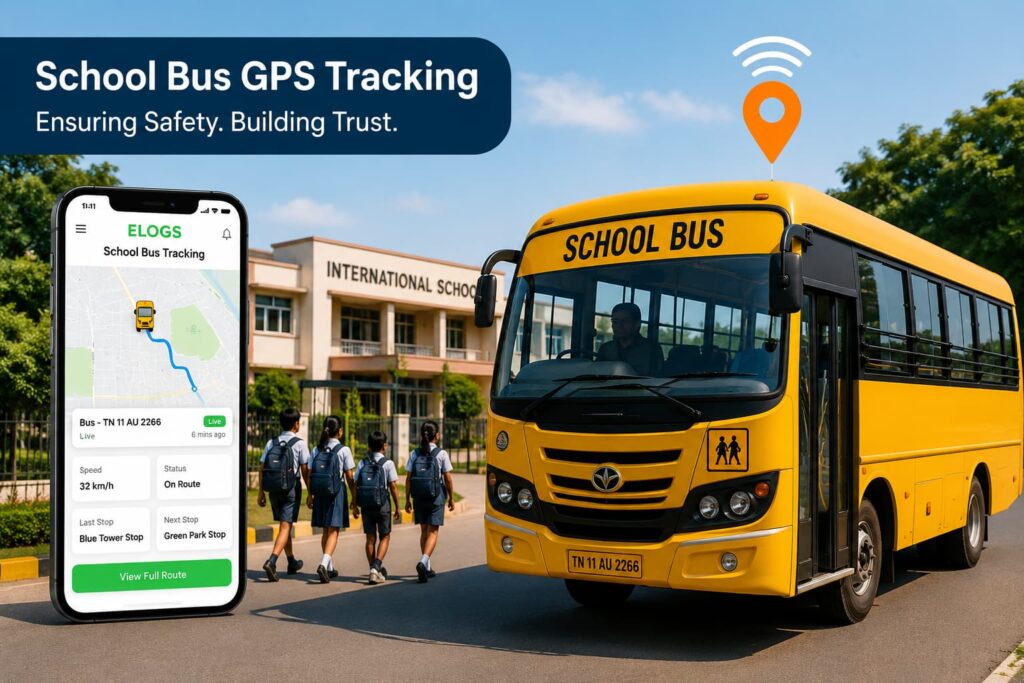
Every school day, thousands of school buses carry millions of students across India. For parents, every minute between drop-off and arrival is filled with quiet anxiety. For school administrators, one missed bus or delayed route can spiral into a crisis. For transport managers, running a fleet efficiently while keeping every child safe is a daily balancing act.
GPS tracking technology has quietly become one of the most effective tools for all three groups. Here’s a straightforward look at how it works and what to look for.
Why School Bus GPS Tracking Matters
The stakes in school transport are uniquely high. Unlike commercial freight, the cargo is children — and errors have consequences that go well beyond financial loss.
The most common problems GPS tracking solves:
- Parents don’t know where the bus is. Calls flood the school office when a bus is late. Parents worry. Staff get distracted.
- Drivers take unofficial detours. Without visibility, there’s no way to know if a bus deviated from its approved route.
- Speeding goes unchecked. Manual monitoring is impossible across a fleet. Alerts don’t happen until after an incident.
- Attendance at stops is guesswork. Schools often don’t know which students boarded or alighted where.
GPS telematics addresses all of these — in real time.
What Parents Get Out of It
For parents, the value is simple: peace of mind.
A good school bus GPS system gives parents access to a live map showing exactly where their child’s bus is. Many systems send automatic notifications — “Bus approaching your stop in 5 minutes” or “Your child has boarded.” Some integrate with mobile apps so parents can check at a glance without calling the school.
This alone significantly reduces the volume of anxious calls to school administrators, freeing up staff time and improving trust between schools and families.
What Schools and Administrators Get Out of It
Schools carry significant duty-of-care responsibility the moment a student boards a bus. GPS tracking provides the documentation and oversight to meet that responsibility.
Key benefits for schools:
- Route compliance: Administrators can verify that buses followed approved routes every single day — valuable for audits and incident reviews.
- Incident response: If something goes wrong, live tracking means the school knows exactly where a bus is and can dispatch help immediately.
- Driver accountability: Knowing their routes are monitored encourages safer, more compliant driving behavior.
- Parent communication: Schools can proactively notify parents of delays rather than waiting for complaints.
For schools managing large fleets — 20, 50, 100+ buses — this kind of visibility is simply not achievable any other way.
What Transport Managers Get Out of It
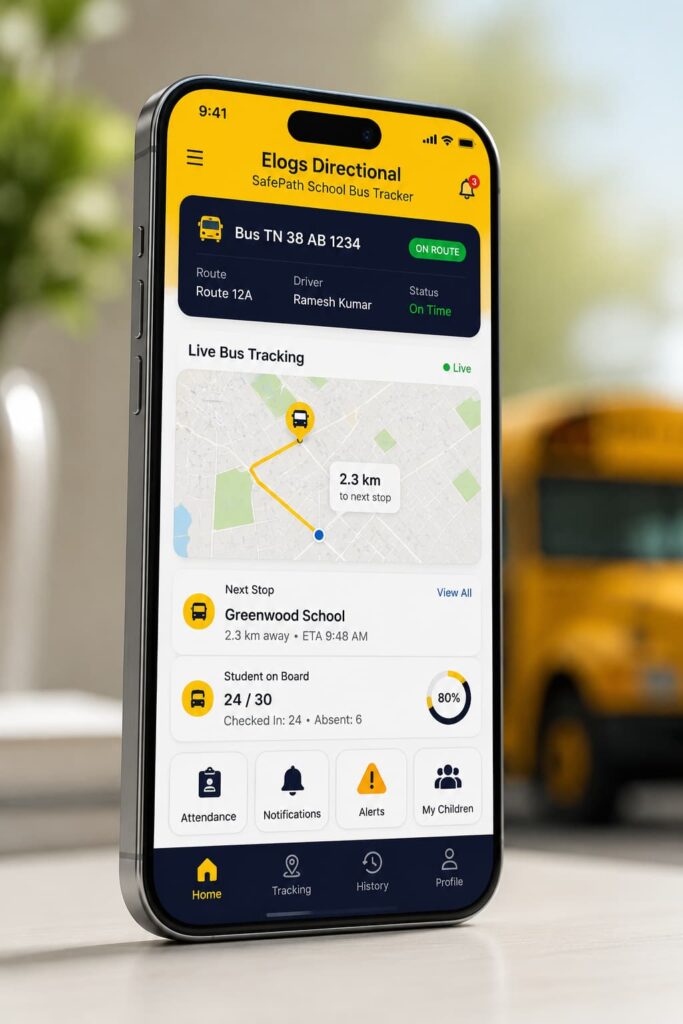
Transport managers are focused on efficiency, cost, and compliance. GPS tracking delivers on all three.
Route optimization is one of the biggest wins. Telematics data reveals which routes are running long, where time is being lost, and whether drivers are idling excessively. Over time, this data can be used to tighten routes, reduce fuel consumption, and cut operating costs meaningfully.
Maintenance scheduling becomes proactive rather than reactive. Vehicle health data from GPS-connected systems can flag when a bus is due for service based on actual mileage and engine hours — not calendar estimates. This reduces breakdowns and keeps the fleet reliable.
Driver performance monitoring gives transport managers objective data on speeding, harsh braking, and rapid acceleration. This feeds directly into safety training programs and helps identify high-risk drivers before incidents occur.
Is GPS Tracking Mandatory for School Buses in India?
Yes — and this is something many schools are still unaware of. Under Rule 125I of the Central Motor Vehicles Rules (CMVR), all school buses in India are required to be fitted with a GPS tracking device. The rule also mandates a panic button for students and an emergency contact system. State transport authorities in Karnataka, Maharashtra, Delhi, and others have issued additional circulars reinforcing this requirement.
Non-compliance can result in permit cancellations and fines during inspections. More practically, schools without GPS tracking are exposed to significant liability if a safety incident occurs and they cannot demonstrate route compliance or driver oversight.
This makes GPS tracking not just a convenience, but a legal and risk management necessity for any school operating its own transport fleet.
What to Look For in a School Bus GPS System
Not all GPS systems are built equally. Here’s a checklist for evaluating options:
- Real-time tracking — updates should be frequent (every 10–30 seconds), not batched.
- Parent-facing app or portal — ease of use matters; a system parents don’t trust or use provides little value.
- Geofence alerts — automatic notifications when a bus enters or exits designated zones (school, depot, stops).
- Speed alerts — instant notifications when a driver exceeds set thresholds.
- Trip history and playback — the ability to review any past route in detail.
- Offline capability — GPS hardware should log data even in areas with poor network coverage, syncing when connectivity resumes.
- Scalability — the system should handle your fleet as it grows, without requiring a platform change.
- Local support — for schools in India, having a vendor with local support and data servers matters for reliability and compliance.
The Bottom Line
School bus GPS tracking isn’t a luxury — it’s increasingly a baseline expectation from parents, regulators, and school boards. The right system makes transport managers’ jobs easier, gives school administrators the oversight they need, and gives parents the confidence that their children are safe.
At Elogs, we work with school transport fleets across India to implement GPS and IoT telematics solutions that are reliable, easy to manage, and built for the realities of Indian roads and operations. If you’re evaluating a system for your fleet, we’re happy to walk you through what a deployment looks like.
Get in touch with the Elogs team →
Frequently Asked Questions
Is GPS tracking mandatory for school buses in India? Yes. Rule 125I of the Central Motor Vehicles Rules (CMVR) mandates GPS devices on all school buses in India, along with a panic button and emergency contact system. State transport authorities enforce compliance during inspections.
How much does school bus GPS tracking cost in India? Costs vary by provider and fleet size. Typically, hardware per vehicle ranges from ₹3,000–₹8,000, with monthly SIM/platform fees of ₹100 per vehicle. Most providers offer volume discounts for fleets of 10 buses or more.
Can parents track their child’s school bus in real time? Yes. Most modern school bus GPS systems include a parent-facing mobile app or web portal that shows live bus location, estimated arrival time, and boarding/alighting notifications.
What happens if a school bus GPS device stops working? A compliant GPS system should have offline data logging — it records location data locally and syncs when network connectivity resumes. Your vendor should also offer replacement hardware and technical support SLAs.
How do I choose the right GPS system for my school fleet in India? Look for real-time tracking (10–30 second refresh), parent app, geofence alerts, speed alerts, trip history, offline capability, and a vendor with local support in India. See our checklist above for the full list.
——————————————————————————————
Published by the Elogs Team | elogs.in